Qué buscas?
En un silenciador de absorción, el núcleo perforado es solo una parte del sistema acústico. El material que lo rodea influye directamente en el ruido de escape, la calidad del sonido, la estabilidad térmica, la vida útil del material de relleno y el estado general del silenciador a largo plazo.
Ese material se conoce generalmente comoempaque del silenciador.
Dependiendo del diseño del escape y del mercado, el mismo componente también puede describirse comomaterial de empaquetadura del silenciador,empaque del silenciador de escape, material de relleno para silenciadores, material de relleno para escapes, relleno acústico, lana para silenciadores o material de amortiguación para escapes.
BSTFLEX suministra y desarrolla materiales de empaquetadura de alta temperatura para silenciadores de motocicletas, sistemas de escape de automóviles, silenciadores de competición, silenciadores industriales, generadores y otros conjuntos de escape.
Explore la gama completa demateriales de empaquetadura de silenciadores.
Un silenciador de absorción típico se construye en torno a una disposición relativamente simple:
Flujo de gases de escape → tubo perforado → capa protectora de fibra → empaquetadura acústica → carcasa exterior
Los gases de escape viajan a través del núcleo perforado. La energía acústica pasa a través de las perforaciones y penetra en el material fibroso circundante.
En lugar de depender únicamente de cámaras o deflectores restrictivos, el material de relleno convierte parte de esta energía acústica en cantidades muy pequeñas de calor mediante la fricción dentro de la estructura de la fibra.
Para que el sistema siga funcionando, el embalaje debe permanecer:
térmicamente estable,
suficientemente resistente,
resistente a la erosión por pulsos de escape,
correctamente empaquetado alrededor del núcleo,
y capaz de mantener su estructura fibrosa tras repetidos ciclos de calentamiento y enfriamiento.
Por eso, elegir un material de relleno para el silenciador de escape basándose únicamente en la clasificación de temperatura rara vez es suficiente.
El material de relleno del silenciador cumple varias funciones simultáneamente.
La estructura de fibra abierta absorbe la energía sonora generada por los pulsos de escape. Esto es especialmente importante en los silenciadores de flujo directo y de alto rendimiento, donde el flujo de gases pasa a través de un tubo central perforado.
El estado del embalaje puede influir no solo en la presión sonora, sino también en el tono del escape.
Por lo general, un material de relleno nuevo produce un sonido de escape más controlado y menos metálico. A medida que las fibras se deterioran, se comprimen, se desplazan o desaparecen, el silenciador puede volverse notablemente más nítido y ruidoso.
La capa de relleno crea una separación entre el tubo perforado caliente y la carcasa del silenciador.
Si bien el material de relleno del silenciador es principalmente un material acústico, sus características térmicas afectan la temperatura de la carcasa y la durabilidad de los componentes adyacentes.
Un empaque estable reduce la carga acústica y térmica directa sobre la carcasa exterior. Un sistema de empaque bien diseñado también puede reducir el deterioro interno del silenciador causado por las vibraciones.
No existe un único material de relleno para silenciadores que sea ideal para todos los sistemas de escape.
La temperatura, la velocidad del gas, el tipo de motor, el intervalo de servicio previsto, el nivel de sonido deseado, la geometría del silenciador y el método de fabricación influyen en la selección del material.
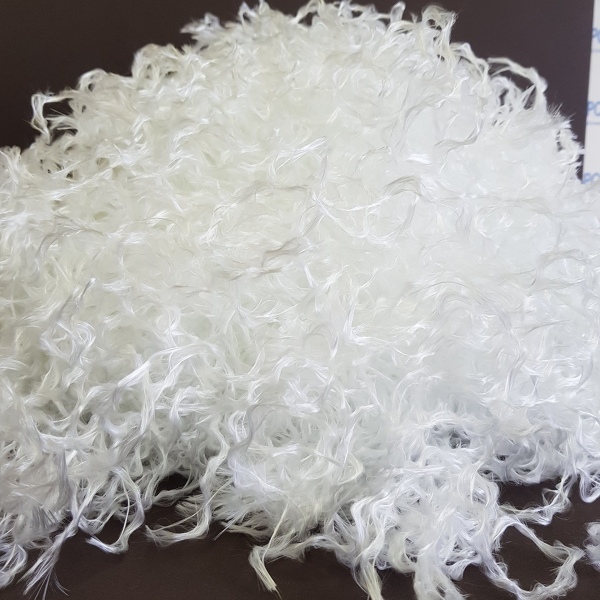
La fibra de vidrio sigue siendo uno de los materiales más utilizados en los silenciadores de absorción.
Combina una baja densidad aparente con una gran superficie de fibra, lo que le confiere una buena absorción acústica sin añadir un peso excesivo.
Las formas típicas incluyen:
hilo de fibra de vidrio suelto,
fibra de vidrio de filamento continuo,
fibra de vidrio texturizada,
esteras de fibra de vidrio,
almohadillas de embalaje de fibra de vidrio,
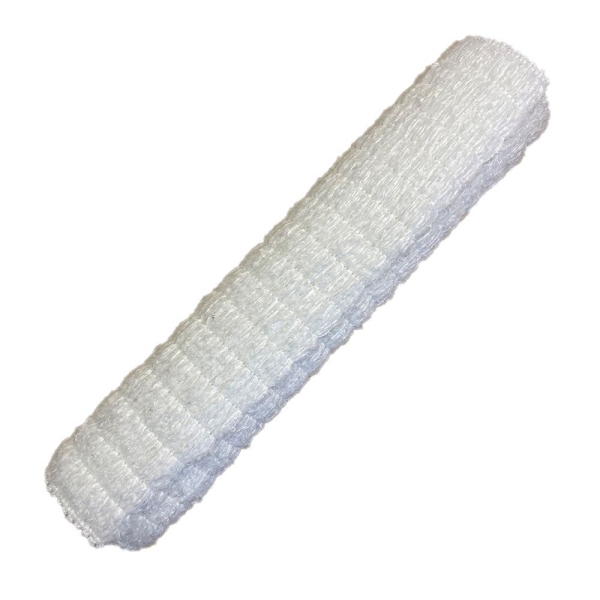
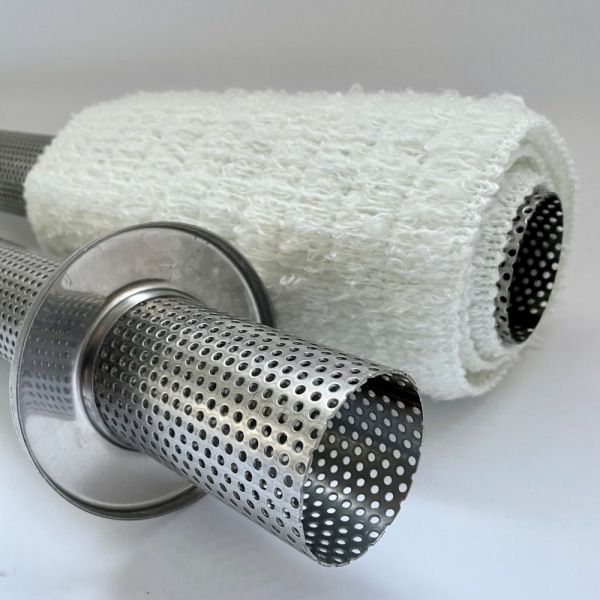
calcetines de embalaje preformados,
y fibra de vidrio contenida dentro de bolsas de malla de vidrio tejida.
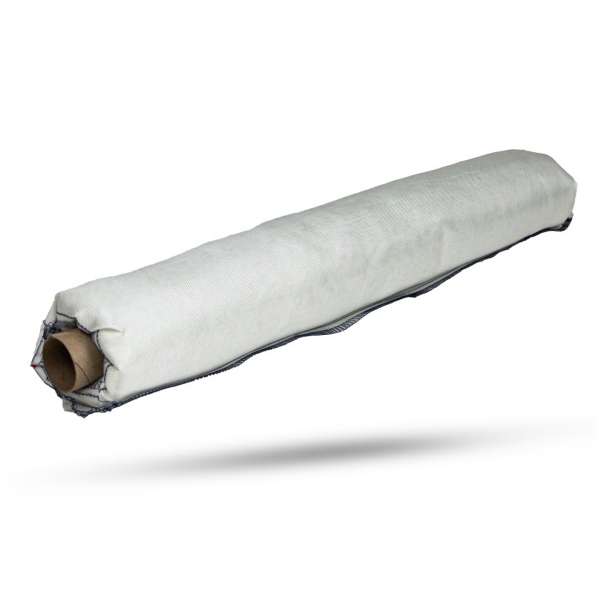
BSTFLEX fabrica unFunda de fibra de vidrio para silenciador con bolsa de malla de fibra de vidrio tejidaPara aplicaciones en las que se prefiere una instalación controlada y la retención de la fibra a un empaquetado suelto.
El relleno de fibra de vidrio se suele elegir para:
silenciadores de motocicleta,
Silenciadores para ATV y UTV,
escapes de alto rendimiento para automóviles,
silenciadores de repuesto,
sistemas de escape de competición,
y muchos silenciadores de absorción de fabricantes de equipos originales (OEM).
Su principal ventaja reside en el equilibrio entre eficiencia acústica, peso, facilidad de fabricación y coste.
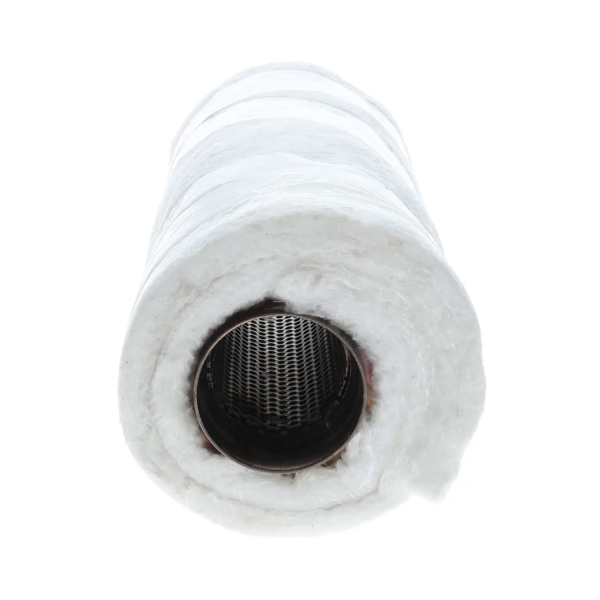
La lana de acero inoxidable cumple una función algo diferente.
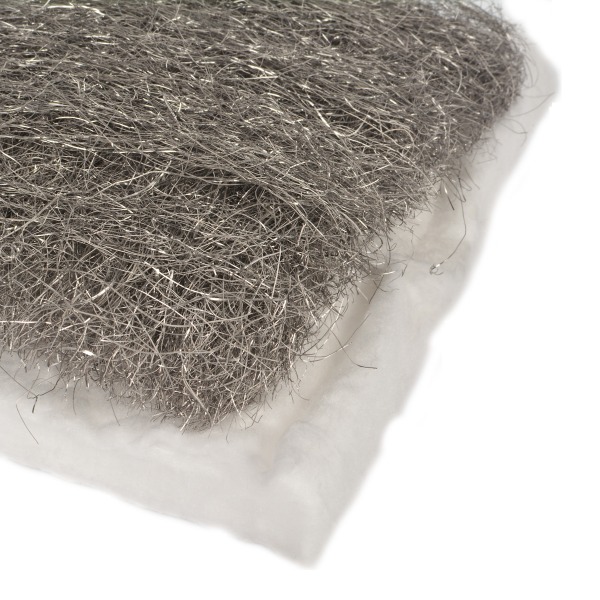
Puede utilizarse como material de relleno, pero en muchos sistemas de escape de alto rendimiento se instala directamente alrededor del tubo perforado como capa protectora.
La disposición típica queda así:
Núcleo perforado → lana de acero inoxidable → relleno de fibra de vidrio → carcasa del silenciador
La capa de acero inoxidable ayuda a proteger las fibras acústicas más blandas de:
gases de escape muy calientes,
pulsos de alta velocidad,
turbulencia alrededor de las perforaciones,
exposición a las llamas,
y rotura progresiva de la fibra.
Esta construcción resulta especialmente útil en sistemas de escape exigentes para motocicletas, vehículos de competición, motores turboalimentados y sistemas de escape de alto rendimiento.
Por este motivo, comparar la fibra de vidrio y la lana de acero inoxidable como si solo se pudiera usar un material resulta a veces engañoso. En muchos silenciadores, cumplen funciones complementarias.
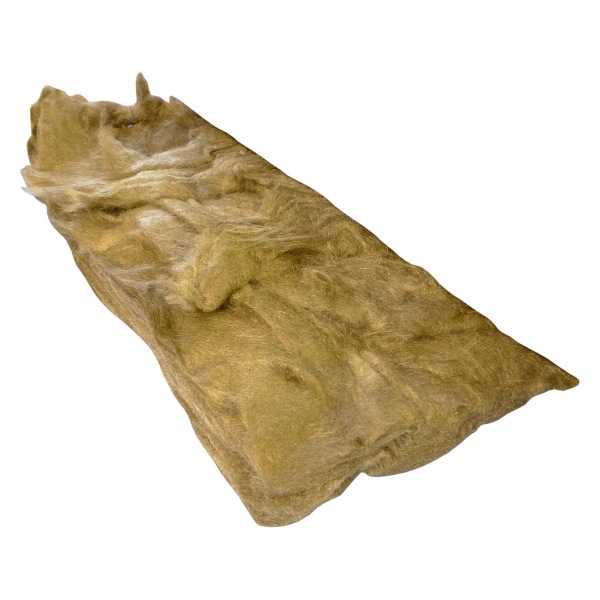
En casos donde las temperaturas de los gases de escape son inusualmente elevadas, se puede considerar el uso de fibra cerámica.
El material de relleno de fibra cerámica para silenciadores resulta atractivo debido a su capacidad para soportar altas temperaturas y a su conductividad térmica relativamente baja.
Entre las posibles aplicaciones se incluyen:
high-temperature industrial silencers,
heavy-duty engine exhaust systems,
certain generator exhaust assemblies,
thermal-intensive exhaust equipment,
and special mufflers operating beyond the practical range of conventional glass fiber.
However, the highest temperature material is not automatically the best acoustic material.
Density, fiber diameter, resilience, vibration resistance, handling requirements, and long-term fiber stability must also be evaluated.
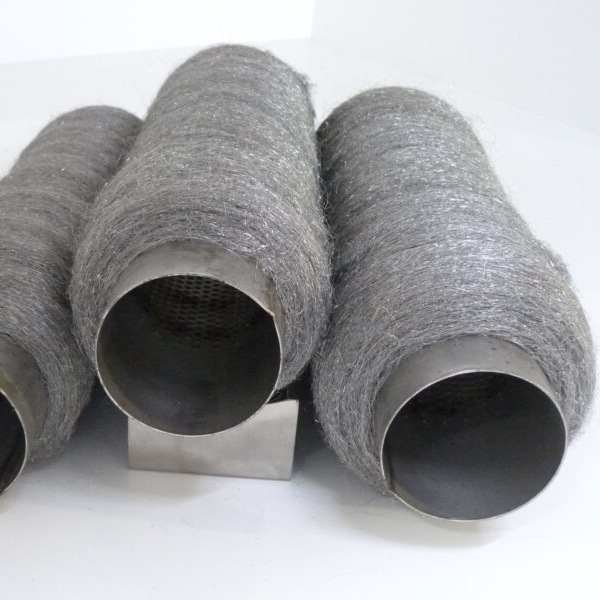
Basalt fiber provides another option between conventional glass fiber and more specialized high-temperature materials.
Produced from volcanic basalt rock, continuous basalt fibers can provide:
good thermal resistance,
mechanical stability,
chemical resistance,
vibration resistance,
and useful acoustic performance.
Basalt muffler packing can therefore be considered for automotive, motorcycle, heavy-duty, or industrial exhaust systems where designers want a mineral-fiber solution with elevated thermal capability.
| Packing Material | Primary Strength | Typical Position | Suitable Applications |
|---|---|---|---|
| Fiberglass | Efficient acoustic absorption | Main packing layer | Motorcycle, automotive, performance exhaust |
| Stainless Steel Wool | Heat and erosion protection | Around perforated core or as metallic packing | Racing, turbo, high gas velocity exhaust |
| Ceramic Fiber | Extreme-temperature capability | Main or supplementary insulation layer | Industrial and severe-temperature silencers |
| Basalt Fiber | Thermal and mechanical durability | Main acoustic packing layer | Heavy-duty, automotive and industrial exhaust |
The correct construction may combine two or more materials rather than using a single fiber throughout the silencer.
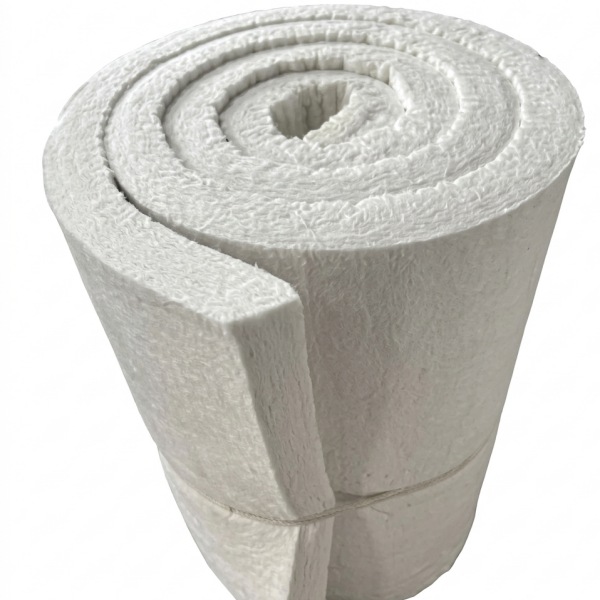
Two mufflers using exactly the same fiber can perform differently simply because the material was installed at different densities.
This is one of the most overlooked aspects of exhaust muffler packing.
If the fiber mass is insufficient, several problems can develop:
reduced acoustic absorption,
rapid fiber movement,
localized empty areas,
increased exhaust noise,
accelerated blowout.
The fibers may also redistribute under vibration and exhaust pulsation.
Over-compression creates another set of problems.
When fibrous material is compressed excessively, the void structure needed for acoustic energy dissipation changes.
The result can be:
poorer sound absorption in certain frequency ranges,
increased silencer weight,
difficult assembly,
reduced fiber resilience,
and unnecessary material consumption.
The goal is therefore not to put the maximum possible amount of packing inside the muffler.
The objective is to achieve a controlled and repeatable packing density suitable for the muffler geometry and target acoustic performance.
Muffler packing works in one of the harshest environments on a vehicle.
The material may experience thousands of heating and cooling cycles together with vibration and rapidly fluctuating exhaust pressure.
Several deterioration mechanisms can occur.
High-velocity exhaust gases passing through perforations gradually attack exposed fibers.
This is often called fiber blowout.
Continuous exposure to elevated temperature can reduce fiber resilience and alter the packing structure.
Vibration can cause loose packing to migrate or compact.
The silencer may develop areas with insufficient material even when the total amount of packing originally installed was correct.
Condensation, oil residue, incomplete combustion products, and other deposits can affect the condition of the acoustic fibers.
A theoretically suitable material may still fail prematurely if it is packed unevenly or installed at the wrong density.
Muffler packing deterioration is not always visible from outside the silencer.
Several operating changes can indicate that the material should be inspected.
Common signs include:
A noticeable increase in exhaust volume
The muffler gradually becomes louder because the effective acoustic mass has decreased.
A sharper or metallic exhaust note
When the packing layer becomes thin, sound energy interacts more directly with the metal shell.
Fibers coming from the tailpipe
Visible strands or particles at the outlet may indicate packing migration or blowout.
Hot spots on the muffler casing
Loss or movement of the internal packing can create uneven thermal distribution.
Rattling or internal movement
This can indicate loose material or deterioration of internal components.
Motorcycle silencers place especially high demands on packing material because the available volume is limited while exhaust temperatures and pulse velocity can be high.
For this reason, motorcycle exhaust packing normally needs to combine:
strong acoustic absorption,
low weight,
good thermal stability,
resistance to vibration,
easy repacking,
and controlled fiber retention.
Both two-stroke and four-stroke engines use packed silencers, but their operating environments differ considerably.
Two-stroke exhaust packing can be affected heavily by oil, combustion residue, and frequent repacking cycles.
Four-stroke performance exhausts may expose the material to higher sustained temperatures and aggressive exhaust pulses.
Selecting packing purely by motorcycle type is therefore insufficient. Muffler construction and engine operating conditions should also be considered.
Performance exhaust manufacturers often need to reduce sound without introducing excessive backpressure.
Straight-through absorption mufflers are useful in this situation because the exhaust path remains relatively open.
The acoustic packing surrounding the perforated core becomes a critical component.
Depending on the application, manufacturers may specify:
continuous fiberglass packing,
stainless steel wool core protection,
composite stainless/fiberglass systems,
basalt fiber,
or specialized high-temperature fibers.
For racing exhaust systems, packing retention becomes particularly important because high gas velocities can rapidly damage exposed loose fibers.
Industrial silencers operate under a different set of requirements.
Applications can include:
diesel generators,
gas engines,
compressors,
turbines,
exhaust treatment equipment,
heavy machinery,
power generation systems,
and industrial ventilation or acoustic control systems.
In these installations, designers may prioritize:
continuous operating temperature,
acoustic absorption over a specified frequency range,
long maintenance intervals,
fiber stability,
corrosion resistance,
and repeatable packing density.
Industrial buyers therefore often purchase muffler packing by engineering specification rather than simply selecting a consumer repacking kit.
Manufacturers normally have several ways to introduce fiber into a silencer.
Loose fibers or strands allow considerable flexibility during assembly.
They work well where the muffler geometry varies or packing is performed manually.
The challenge is maintaining consistent density from one muffler to another.
Mats provide more predictable thickness and make material handling easier during production.
They are especially suitable when the silencer has a regular cylindrical geometry.
A measured amount of fiber is enclosed inside a lightweight retaining fabric or mesh.
This allows manufacturers to control fiber mass before installation.
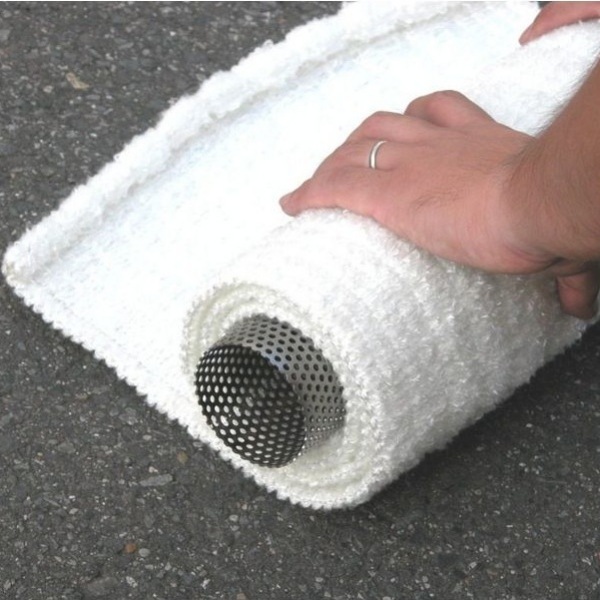
A tubular packing assembly can be fitted around the perforated core, reducing installation time and helping maintain circumferential coverage.
BSTFLEX develops customized packing formats including fiberglass-based assemblies for OEM exhaust production.
A purchase specification should contain more information than simply:
“Fiberglass muffler packing.”
For repeatable production, buyers should consider supplying:
| Specification Item | Why It Matters |
|---|---|
| Fiber material | Determines thermal and mechanical behavior |
| Silencer internal diameter | Defines available packing space |
| Perforated core diameter | Determines required packing thickness |
| Muffler length | Determines fiber quantity |
| Target packing density | Influences acoustic performance |
| Continuous exhaust temperature | Determines material suitability |
| Peak temperature | Identifies short-duration thermal exposure |
| Engine type | Helps evaluate exhaust environment |
| Packing format | Loose fiber, mat, pillow, sock or custom assembly |
| Annual quantity | Determines manufacturing and packaging method |
When these parameters are available, the packing can be engineered around the silencer rather than supplied as a generic bulk fiber.
Manual loose packing creates several variables.
One operator may install more material than another. Distribution around the perforated tube may also vary.
Preformed systems reduce this variability.
A packing sock, bag, pillow, or measured mat can provide:
defined material weight,
more uniform circumferential distribution,
reduced fiber handling,
shorter assembly time,
cleaner production,
improved batch repeatability.
For medium- and high-volume exhaust manufacturing, those manufacturing benefits can be as important as the thermal properties of the fiber itself.
A practical starting point is to identify the dominant failure risk.
Consider fiberglass as the primary acoustic layer.
Consider a stainless steel wool or metallic mesh protection layer before the main fiber packing.
Evaluate ceramic or other elevated-temperature fibers.
Consider materials and packing forms with stronger dimensional stability and controlled retention.
Consider preformed socks, pillows, mats, or custom packing assemblies rather than uncontrolled loose fill.
BSTFLEX manufactures high-temperature thermal and acoustic materials for exhaust systems and can support both replacement packing and OEM silencer production.
Available development options can include:
fiberglass muffler packing,
glass fiber silencer packing,
stainless steel wool packing,
ceramic fiber packing,
basalt-based packing,
loose fiber,
mats,
rolls,
packing bags,
packing pillows,
tubular packing socks,
and customized preformed assemblies.
Sizes, packing weight, fiber combination, retaining construction, and packaging can be developed according to customer drawings, samples, or silencer dimensions.
For applications requiring easier assembly and improved fiber containment, see theFiberglass Muffler Packing Sock with Woven Glass Mesh Bag.
For additional material options, visit theBSTFLEX Muffler Packing category.
There is no universal best material. Fiberglass is widely used because of its acoustic efficiency and weight, stainless steel wool is effective for protecting packing near the perforated core, while ceramic and basalt fibers may be selected where higher temperature capability is required.
Yes. Fiberglass is one of the most common acoustic materials used in absorption-type exhaust silencers because its fibrous structure provides efficient sound absorption while remaining relatively lightweight.
It can be used alone in some designs, but stainless steel wool and fiberglass often perform different functions. Stainless steel wool can protect the inner packing from exhaust erosion, while fiberglass provides the principal acoustic absorption layer.
Packing can escape because of fiber erosion, excessive gas velocity, damaged retaining mesh, incorrect packing density, thermal degradation, or deterioration around the perforated core.
Not necessarily. Excessive compression can reduce the open fiber structure needed for effective acoustic absorption. Packing density should be controlled rather than maximized.
There is no fixed interval for every exhaust system. Replacement frequency depends on exhaust temperature, engine type, riding conditions, packing material, gas velocity, silencer design, and operating hours.
Sí. El embalaje OEM se puede suministrar según el diámetro del núcleo, el diámetro de la carcasa, la longitud del silenciador, el peso objetivo del embalaje, las especificaciones del material, los requisitos de temperatura y el formato de instalación preferido.
La carcasa visible del silenciador suele acaparar la mayor parte de la atención durante el diseño del sistema de escape, pero el material oculto entre dicha carcasa y el núcleo perforado determina una parte importante del comportamiento acústico del silenciador.
Un diseño correctamente elaboradomaterial de empaquetadura del silenciadorNo debería simplemente sobrevivir al calor.
Debe mantener la relación adecuada entre la estructura de la fibra, la densidad, la absorción acústica, la resistencia a la erosión y la uniformidad de la instalación.
Para los silenciadores estándar de motocicletas y automóviles, la fibra de vidrio sigue siendo una de las opciones más versátiles. Para entornos de escape exigentes, la lana de acero inoxidable, la fibra cerámica, la fibra de basalto o las combinaciones multicapa pueden prolongar su vida útil.
Para los fabricantes de sistemas de escape OEM, el siguiente paso no es simplemente elegir una fibra.
Está definiendo lo correctosistema de empaquetadura del silenciador de escapepara la geometría del silenciador, la temperatura de los gases de escape, el objetivo acústico y el método de producción.
BSTFLEX puede fabricar y personalizar materiales de relleno para silenciadores destinados a sistemas de escape de motocicletas, automóviles, vehículos de competición, generadores, embarcaciones e industria.
Póngase en contacto con BSTFLEX e indíquele las dimensiones de su silenciador, la temperatura de funcionamiento, el formato de embalaje requerido y la cantidad anual para la selección de materiales y el desarrollo de muestras.

No.10, Chuangxin North Road, Nanshan Park, Ningguo Economic and Technological Development Zone, Ningguo City, Anhui Province, China
teléfono/Whatsapp : 0086-15856303740
Email : sales@bstbraidedsleeve.com
Skype : vanesa-cheng